V-1 Flying Bomb Launch Site 1/35
To carry out the planned V-1 ‘flying bomb’ attacks on the United Kingdom, Germany built a number of military installations, including launch sites and depots. Some installations were massive concrete fortifications.
The Allies were aware of the locations at an early stage and carried out numerous bombing raids to destroy them before they were put into use.
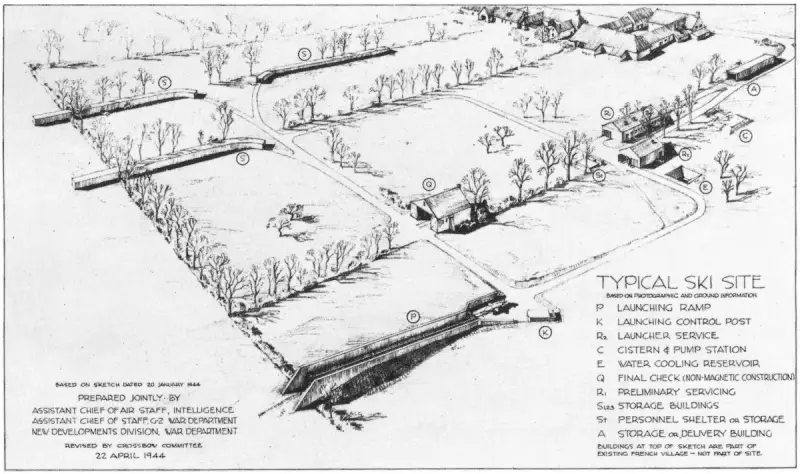
In autumn 1943, the Germans began building launch bases for the V-1 flying bomb (Also known as the FieslerVergeltungswaffen 1 FZG-76 (V1).) at sites scattered across northern France. The pilotless planes were supplied by rail from production factories in Germany and were prepared and fired from a launch ramp at each site.
Once launched, the V-1 flying bomb, only flew a straight flightpath. This meant the launch ramp had to be pointing directly toward the target area. The determination of distance from the ramp to the target was of great importance since the V-1 used a nose mounted anemometer to determine distance flown. Once the anemometer reached a preset count it triggered a special control valve that turned off fuel to the pulse jet. The accuracy of this system was less than optimal and undoubtedly contributed to the low number of V-1s striking their target.
Pulse jets are the easiest to manufacture and the simplest power sources for an aircraft. They have very few moving parts and are extremely simple in operation. However in order to work air has to be forced into the pulse jet intake. This means the V-1 has to be moving in order to keep the the pulse jet functioning. The German's overcame this problem by launching them from a static site with a steam catapult. The steam generator used concentrated hydrogen-peroxide (T-Stoff) and potassium or sodium permanganate with water (Z-Stoff). The T-Stoff and Z-Stoff would instantly flash to steam and power the catapult sending the V-1 down the 160 foot launch ramp at a speed well above it's stall speed of 200 MPH. The V-1 would continue to accelerate until it reached it's cruising speed of 340 MPH.
It is a misconception that the catapult was needed to start the pulse jet. The pulse jet engine was started prior to launch by the Anlassgerät (starting unit or engine starter), which provided compressed air for the engine intake, and electrical connection to the engine spark plug and autopilot. The spark plug was only needed to start the first pulse of the engine, the residual heat from the previous pulse ignited further mixtures of T-Stoff and Z-Stoff. The pulse jet would reach full power after 7 seconds and catapult would be triggered launching the V-1 into the air.
The basic design, small size and simplicity of the launch site allowed German engineers to quickly construct it. Forty men took 2 weeks to construct the site, including the 7 days required to construct the launch ramp.