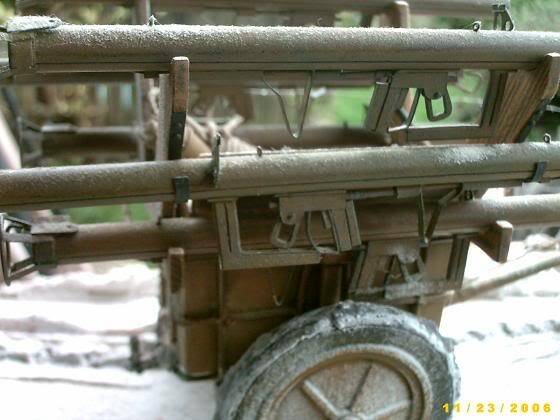
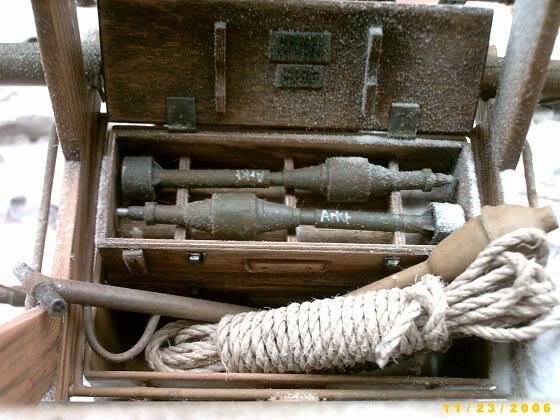
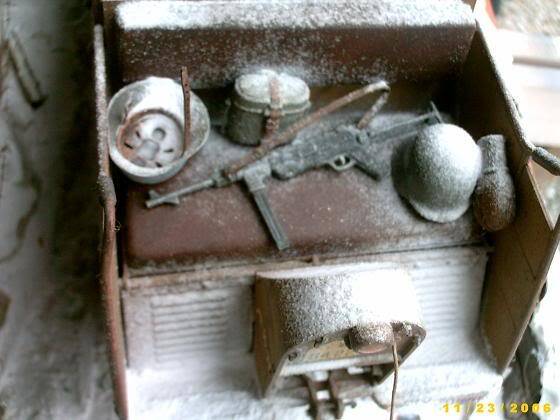
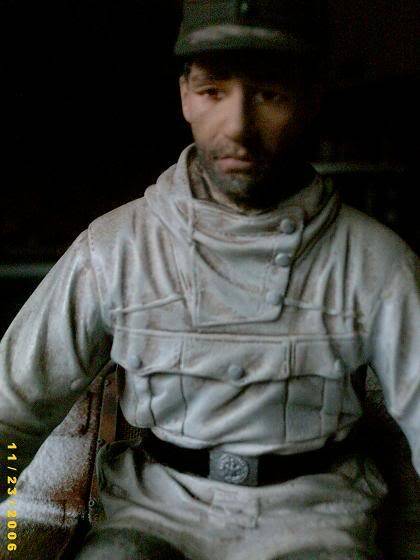
German WWII Kettenkraftrad with Cart and Goliath 1/16
The Sd.Kfz.2 (kleines Kettenkraftrad Sd.Kfz. 2) is a German light multi-purpose vehicle from World War II. This vehicle was a kind of combination of a motorcycle and a tracked tractor. The prototype was built in 1940 at the NSU factory. In June 1941, it was officially adopted into the Wehrmacht's armaments program. More than 8,000 of these vehicles were built by 1945. Interestingly, production continued after the war for civilian use. The Sd.Kfz.2's primary tasks were transporting small loads, towing light artillery, and laying telephone cables. The Sd.Kfz.2 saw extensive service from 1942 onward, primarily in North Africa and on the Eastern Front. The vehicle had excellent off-road capabilities and a high top speed. Its drawback was its highly complex structure, particularly its suspension. Technical specifications: Length: 3 m, Width: 1 m, Height: 1.2 m, Engine power: 36 hp, Range (on roads): 250 km, Maximum speed (on roads): 70 km/h, Armament (security vehicle version): 1 machine gun MG-34 7.92 mm.
The Goliath (full name: Leichter Ladungstrager Sd.Kfz. 302, 303) was a German light self-propelled landmine from World War II. The mine was powered by two electric motors or a single 12.5 hp internal combustion engine. Mass production of this unusual weapon took place between 1942 and 1944, with approximately 7,700 self-propelled mines of this type manufactured. Depending on the version, it could carry between 75 and 100 kg of explosive charge.
Goliath The design of the Goliath self-propelled mine was based on a captured prototype vehicle by the French engineer Adolphe Kegresse, which was taken over by the Germans after the fall of France in June 1940. Borgward Werke developed an improved version for the Bundeswehr (West German Army) based on this design. Two versions of the Goliath were developed during production: the first (Sd.Kfz. 302) was powered by two electric motors, and the second (Sd.Kfz. 303) had a much less reliable internal combustion engine. The mine was controlled and detonated by a special cable trailing behind it. The drawbacks of this weapon (in the Sd.Kfz. 302 version) were the highly unreliable emergency motors and the general disadvantage of the wired steering system, which was very susceptible to damage and destruction. Production costs were also relatively high for a disposable weapon. German troops used the Min Goliath during the Siege of Sevastopol (1941-1942), the fighting at Anzio, and during the suppression of the Warsaw Uprising in 1944.
Early model, own trailer. 1/9